
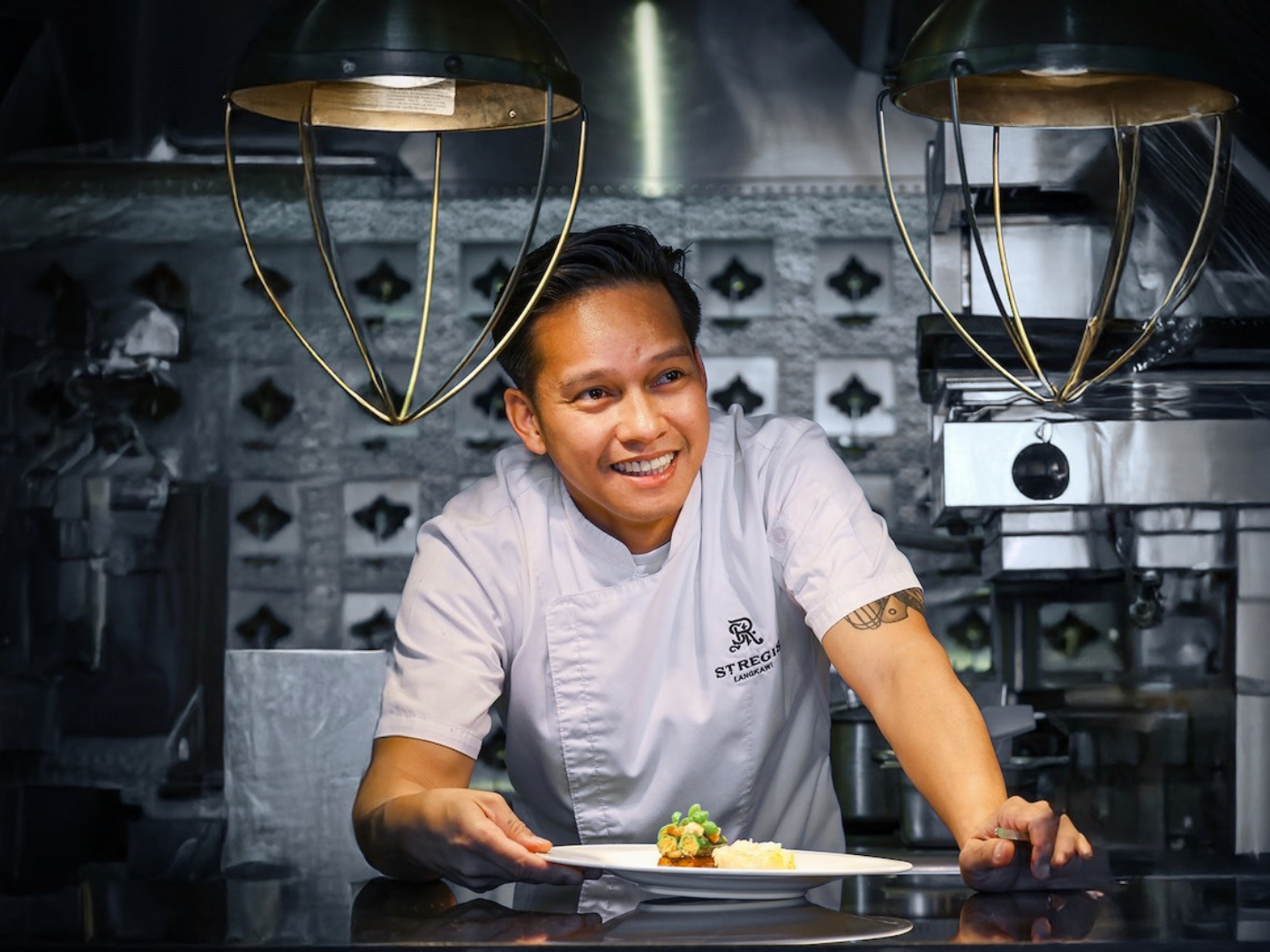
The St. Regis Langkawi’s crown jewel, Kayuputi’s, new Chef de Cuisine on a career spent learning to edit, and the one question he asks of every dish: does it belong?

On the afternoon before a four-hands dinner with Joëlle Jakarta, Chef Marco J. Portal Jr. leaves a kitchen where his cooks are steadily working through their prep and meets me in The Loft, a double-height room at Kayuputi beside the bar’s sunset deck, where the afternoon light arrives direct and fills the space. With a menu to finish, a visiting chef he met in person only the night before and a dining room to open at six, Portal gives me the afternoon anyway—visibly anxious and as, in his own words, an introvert.
Since March 2026 he has led the kitchen of a restaurant that guests cross an island to dine at—the attention that comes with it is still new to him. I tell him that it gets easier and that there will be many more conversations like this one on the road ahead.

Crossing the Pass
Having never sought out the chef life, Portal majored in hotel and restaurant management in the southern Philippines because a degree seemed worth having, yet the future he first imagined for himself was in the military. His first job on the floor of a restaurant suited him no better—glasses broke every other day and orders went wrong, but a bad shift still had to be met with a smile.
The turning point came in an all-day dining restaurant in the Middle East with an open kitchen, as he watched cooks who were as busy as anyone on the floor and still managed to smile while coaxing guests into tasting dishes they would never have ordered, and he crossed over to learn from the chefs beside him and not from a classroom. Portal does not remember it as one dramatic moment. “It developed while I was working on the floor and watching the kitchen during service,” he says, until he could see everything a guest never does, from the communication and the discipline to the timing and the pressure of many people working so that one plate arrives the way it should, and “eventually, watching from the other side was no longer enough.“

Portal’s first pride as a cook came not from anything complicated but from the day he cooked with intention instead of following instructions, with the seasoning right and the elements working together and the plate close to the one he had imagined. He watched someone else taste it and understand what he had been trying to do, which, he says, gave him confidence.
First, You Observe
The chefs that mentored him were not gentle but they were good leaders. Portal spent thirteen years in the Middle East, working beside demanding cooks such as Jason Atherton and Tristan Farmer and found himself looking forward to it every day.
From Chef Oscar Perez, a Filipino culinary director raised in Denmark, he took a rule for arriving anywhere new, which is that you should not walk in believing you already have the answers. “First, you observe,” Portal says, because ingredients do not behave the same in every country and neither do the humidity, the equipment or the working culture, and “you need curiosity, but you also need humility.“
A year in Singapore led to Kuala Lumpur and the kitchens of Potager and Skillet, where Chef Masashi Horiuchi taught him to study an ingredient closely and to see how small decisions in preparation can change the result, and where Chef Raymond Tham deepened his command of contemporary French technique and of the organisation behind consistent service, in which every sauce, garnish and component was prepared and tasted, and every cook knew their role, before the first order arrived. The lesson Portal keeps from those years is that “adding more does not automatically make a dish better.“
Developing A Taste for Balance

Asked to define his cooking, Portal answers in a single word: “simple,” by which he means simplicity, craftsmanship and the satisfaction of the guest, along with a habit from his travelling years of studying a place and its food before cooking in it, so that a plate elevates familiar flavours through modern technique.
The craft lives in the tasting. Every afternoon at five Portal walks each section and tastes the sauces and purées, listening first for balance, for whether the acidity is right and whether the sauce supports the main ingredient or turns too heavy, and then for the finish, since a sauce can seem fine for a second and then go flat, bitter or too rich.
“I don’t automatically reach for salt,” he says. “First I want to understand what is actually wrong,” because seasoning applied to a weak foundation only hides the problem, whether the fault lies in the acidity, the reduction, the freshness or aromatics that never developed. The purées receive the same scrutiny for texture and temperature, smooth and yet still tasting of the ingredient, because the aim, he tells his cooks, is not for every component to impress on its own but for everything to work together on the plate.

Kayuputi’s Chef de Cuisine is equally wary of luxury used as shorthand—wagyu, truffle and caviar can find their place on a menu purely because they signal expense, and so when the market asks for premium proteins he does the development work to make them belong to a dish rooted somewhere. Of caviar, he asks what it contributes beyond its name, whether its salinity, its texture, its behaviour against temperature or the contrast it gives to sweetness or richness, and the test is put bluntly: “If I remove the caviar and nothing changes,” he says, “then I have to ask whether it really belonged there.“
Making Sense of Langkawi
Langkawi asked him to unlearn the pace of big cities, where ingredients, suppliers and people are a phone call away. On the island, availability shifts, deliveries need planning and the weather decides what arrives. Portal admits that the first months frustrated him, since a chef who wants things done on time and to standard found that a willing yes from his cooks doesn’t always arrive with the urgency he was used to. Eventually, he understood that on an island he had to slow down and learn the people before he could lead them.

After two or three months of give and take, with requests discussed and met halfway in both directions, the kitchen found its rhythm, and running it has made him more patient and more organised, and has also taught him to explain the reason behind a task before he gives the instruction, since a cook who understands why makes better decisions alone: “For me now, leadership starts with listening.“
Portal calls his cooking French-based, having learned from the chefs he worked beside and from asking why each dish is made the way it is while never having been to France. “French techniques give me structure,” he says. “My memories, the ingredients and the place where I am cooking give the dish its identity.” Filipino by birth, Dubai-trained, French in method, Japanese in appetite and currently Malaysian by address, his goal is clear: “At Kayuputi, I don’t want to cook food that could be served anywhere. It still needs to make sense in Langkawi.“
His life on the island runs between the kitchen and his family. He has his wife and their baby with him, and that, he says, is what keeps the balance, with days off spent by the sea at Tanjung Rhu and breakfasts of fresh roti at a shop near the resort on the mornings that he can.

Of Flan and Fowl

At the dinner the next evening, the pasta he had described to me as a problem of balance, French and Japanese at once and filled with duck, took the form of a single tortelloni with the kamo dashi poured around it, and what struck me first was how light the broth was and how balanced the whole dish remained around it. I still find duck overrated on Western tasting menus and still prefer it in Asian preparations, so a clear Japanese-style broth was the right way to meet it.
When the menu was divided between the two kitchens Portal volunteered for the snacks and the bread, the opening gestures of a dinner that guests rarely credit to anyone, and he and Fadli settled the rest by choosing the dishes each could source and cook with the most confidence, since the guest kitchen had travelled from Jakarta.
READ ALSO: Joëlle Takes a Seat in the Collector’s House at Kayuputi Langkawi

Asked which of his four dishes that night is most like him and which is most like Kayuputi, Portal gives two different answers. “The leche flan probably tells you more about Marco,” he says. “The guinea fowl tells you more about where I want to take Kayuputi.“
The flan he grew up with was never a restaurant dessert but a dish made to share whenever people gathered around a table, and what he remembers is its richness and its silky texture, so that for the dinner he kept the memory recognisable beside mango compote, calamansi gelato, a brown-butter sablé and meringue because, according to him, “you can change the presentation and refine the technique, but you cannot lose the flavour or memory that made you love the dish in the first place.” Easier with me than he had been the afternoon before, Portal was eager to tell me as the night ended that it was his mother’s recipe.
The guinea fowl arrived with kabocha and maitake and a smoked eel bordelaise lifted by sansho and pickled ginger on a French foundation, and it is how he increasingly sees the food at Kayuputi, which is “strong technique underneath, but the personality should come from this part of the world.” When Portal came out with Chef Ryan Fadli to present the mains, he spooned the sauces over the plates himself.

Stepping Into the Light
Portal says it plainly, in writing and in person: the dining room is not where he feels most himself, and cooking beside a guest chef has helped his confidence even as the nerves have not entirely left. “I am naturally more comfortable inside the kitchen,” he says. “That is where I have more control and where I am used to communicating through food.” Before stepping out he needs to know that the kitchen is stable, or, as he puts it, “physically I may be talking to a guest, but mentally I am still standing in the kitchen.“
So Portal spends the whole day making sure that the last minute before service asks nothing of his nerve. His day moves from emails, orders and deliveries to a briefing with his cooks at two and a walk through the sections at five, with thirty minutes to himself before service begins at six, by which time the extraction fans are running and the kitchen smells of stocks, butter and warming sauces, controlled but never silent, as he describes it. “That last minute before service is not really the time to create confidence,” he says. “The work you have done throughout the day should already have created it.“

The walk into the dining room, he still thinks, is worth taking, because guests want a connection with the people who made the food and because it lets him hear how someone experienced a dish: “I try not to make it a performance. I explain what we were trying to do, and I listen.“
Given A Place on the Menu

There are always dishes that are not ready, he says, and the reason is rarely a missing component: “Sometimes all the elements technically work, but I still cannot explain why that dish belongs at Kayuputi. That is what I am looking for.” It is the test he applied to the tortelloni he chose not to adorn, for earlier in his career Portal would probably have kept adding, and he now holds that “simplicity does not mean less work. Sometimes it takes more confidence and discipline because every element that remains is exposed.“
His curiosity does not stop at the pass. A week before our exchange he went fishing on a day off with colleagues and came home with a catch unfamiliar to him, which he prepared in an asam pedas as advised; and in a salad he found a leaf that tastes of young mango—fruity and tart, whose name he has yet to learn. It will need to be given a place on a coming menu.
When we were finished, Portal is visibly relieved—laughing that he sweated through every minute of it and thanking me for the conversation, which I tell him is mutual, and I say that I look forward to dinner the next evening and to seeing him again soon.
Chef Marco J. Portal Jr. is the Chef de Cuisine of Kayuputi at The St. Regis Langkawi. Reservations and upcoming Gastronomy Series dinners at kayuputilangkawi.com or @kayuputilangkawi. Access and selected images courtesy of The St. Regis Langkawi.
From the table to the world beyond, Nacre brings you dining, travel, and lifestyle experiences worth savouring. Explore more with us on Instagram (@nacre.asia).

Leave a Reply