
Jakarta’s Joëlle joined Chef Marco Portal at Kayuputi for a seven-course Gastronomy Series dinner, where two kitchens traded courses over Billecart-Salmon champagne at The St. Regis Langkawi.

I’m seated in the centre of a room called The Peacock, where alabaster tables are flanked by tall chairs adorned with white peacock feathers. A dashi consommé is poured around a single tortellino with a crown of shiitake. It is the third course of seven, presented by Chef Marco Portal Jr. The course before it came from Jakarta by way of Joëlle and the one after will too.
Outside Kayuputi, the sun finished its descent and darkness fell over the Andaman. Earlier, we had gathered at the Kayuputi Bar for a round of welcome champagne, watching the sun set in the west of Langkawi island, while the resort’s general manager Derek Gomez introduced guests to Portal, Chef Ryan Fadli and Billecart-Salmon‘s Asia Pacific director, Sebastien Papin, who shared the story of his prestigious house with enthusiasm.
A Collector’s House on the Water
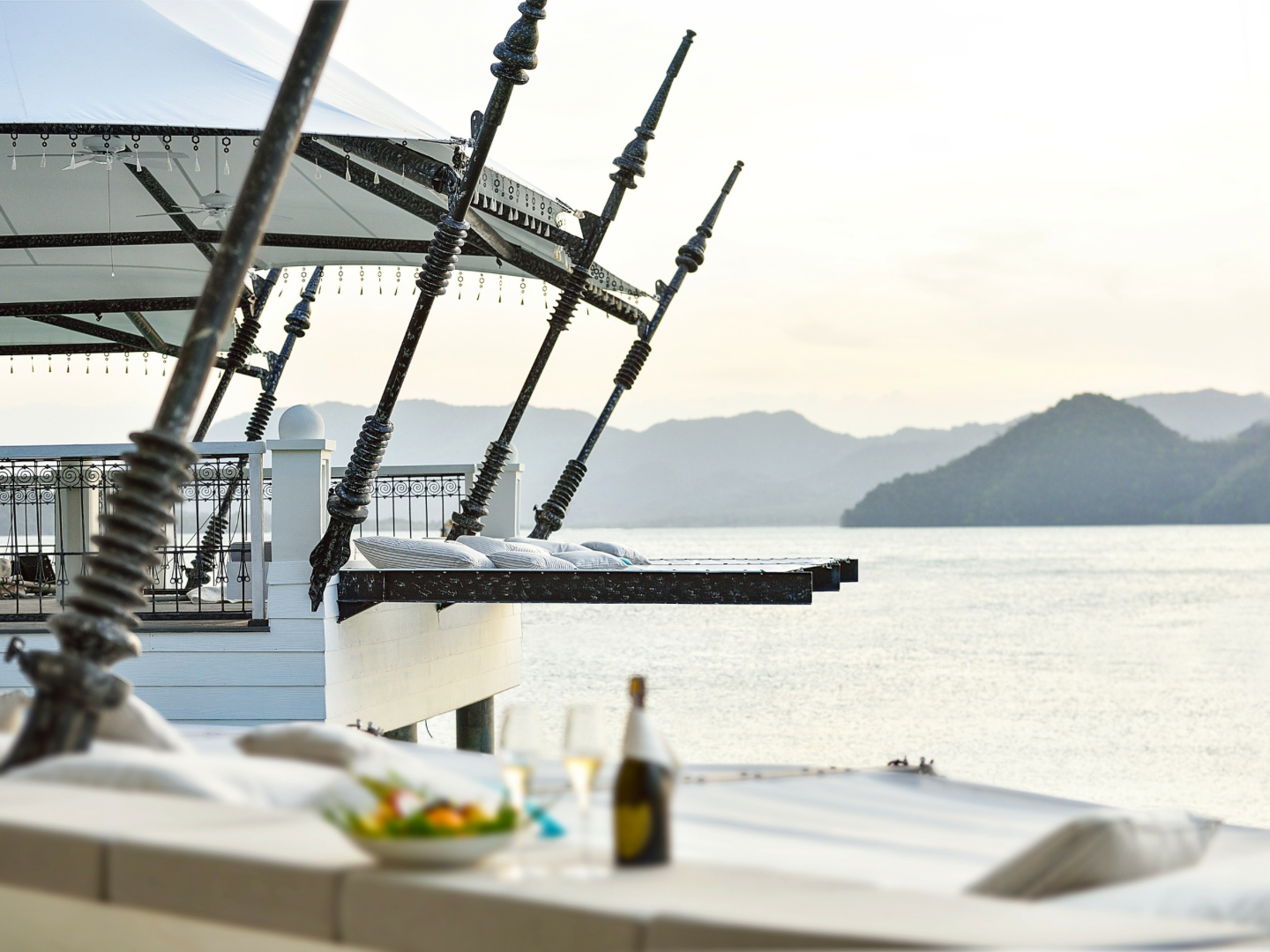
Bill Bensley designed Kayuputi as an art collector’s home on the water, and that home regularly plays host to extraordinary chefs and wine houses from all around the world. The collection is real: doors and windows more than a century old from the former Dutch embassy in Yangon, sixty teak columns inlaid with camel bone from India, vases recovered from shipwrecks and still crusted with barnacles. Kayuputi comes from kayu putih, Malay for white wood, and the restaurant stands on ivory stilts over the Andaman Sea, joining The St. Regis and The Westin by a wooden bridge.

Hosting is the idea behind The Gastronomy Series, a run of special menus that put a guest in the spotlight, sometimes a visiting kitchen and sometimes a wine house. It began in 2025 with a four-hands dinner alongside the kitchen of The St. Regis Kuala Lumpur and has since welcomed HAOMA Bangkok, Lerouy Singapore, ESA Jakarta, the Loire winemaker Pascal Jolivet for the resort’s tenth anniversary and Akar from Kuala Lumpur.
In October the guest was Joëlle, a brasserie in Jakarta’s Senopati neighbourhood that opened in late 2024, which earned a bronze among Indonesia’s 30 Best Restaurants at the 2025 PRESTIGE Gourmet Awards. Its core inspiration is Joël Brasserie in Atlanta: high-end French cooking, warm hospitality and a communal spirit. Executive Chef Ryan Fadli arrived in Langkawi for two dinners alongside Chef de Cuisine Marco Portal Jr, a Filipino chef who trained in Dubai and Kuala Lumpur and has led Kayuputi’s kitchen since March.

Taking Turns at the Table
The menu card named the kitchen behind each course, and the two kitchens took turns. Both chefs planned the dinner from a distance, comparing each other’s dishes before they met. “We didn’t want it to feel like, ‘This is a Joëlle course, now this is a Kayuputi course,’” Fadli says. “The menu had to make sense as one experience.”

His courses spoke brasserie French, and spoke it generously. The king crab arrived wrapped end to end in sliced avocado, messy to eat and clean on the palate, every ingredient distinct and better together. The black cod was a hefty centre-cut fillet, pearlescent, slicing cleanly and flaking under pressure, with the mousseline moulded over it like a toupee and lemon and capers adding brightness and a salty zing. The filet de boeuf farci, stuffed with foie gras and spinach under a mustard seed jus, was brasserie cooking at its most traditional. A Joëlle dish, he says, has a reason for every element, and “a sauce that brings everything together.”


Portal’s French foundation travelled east. The duck tortelloni was handmade, with a toothsome bite and a filling of savoury shredded confit, and the kamo dashi poured tableside was as light as a consommé, a starter that made east meet west with ease. He weighed adding another element and ultimately left it out. “If I remove it, do I miss it? If the answer is no, it should not be there.”
The guinea fowl came two ways, a firm breast with crisped skin and a leg roulade, with a fantastic kabocha purée whose intense sweetness suited the fowl, while eel, squash and maitake gave it an unmistakable East Asian accent. The smoked eel bordelaise was strong, salty and almost overwhelming, and I felt it could be dialled down a little.


The leche flan, his mother’s recipe, was silky smooth with a good set, its toasted meringue adding smoky, caramelised notes that met the calamansi like a citrus meringue pie. I am no authority on Filipino flan, but custards are a favourite of mine. Of the flan, he says his mother “might also ask me why I needed to put so many other things around it.”
Read casually, the menu was one seamless dinner. Look closer and the hands showed: Portal’s French-Japanese flavours against Fadli’s truer French, which was how you knew it was a collaboration. The back and forth did it best, from Joëlle’s light crab and avocado to Kayuputi’s earthier tortelloni, Joëlle’s clean fish to Kayuputi’s heavy fowl, and back to Joëlle’s classic beef. The seams were where the conversation between the two kitchens was most evident. Sauce was the common thread of the evening, spooned and poured at the table: the kamo dashi over the tortelloni, the bordelaise over the guinea fowl, the jus over the filet. Both chefs came out to present their mains and spooned the sauces over the plates themselves.

Fadli, reserved at first, laughed and opened up once he was comfortable, and both chefs went from tense before service to visibly relieved after it. Asked which of Fadli’s courses he would have liked to cook himself, Portal picks the black cod and says he would keep it as it was. “You don’t need to make the other chef cook like you.” Fadli puts the result in one sentence: “French technique gave us structure, while the flavours and ingredients of this region gave the menu its personality.” My favourite of the evening was a tie between the fish and the fowl—one clean and refined, the other bold and unapologetic.

Elisabeth’s House
What is dinner at The St. Regis without champagne? Five of the six pours that evening came from Billecart-Salmon, the house whose Brut Le Blanc de Blancs is sabered daily at the resort’s evening ritual. It began with a marriage: in 1818 Nicolas François Billecart married Elisabeth Salmon in Mareuil-sur-Aÿ, her brother Louis Salmon, passionate about oenology, made the wines, and while Nicolas travelled to sell them, Elisabeth ran the house and the business at home. Seven generations later it is still family-owned, and Papin spoke proudly of the vineyards it farms itself.
The first pour was Le Réserve, served from a magnum with the amuse-bouche, and Papin explained that a larger bottle ages better and for longer, because of the ratio of lees to wine, and limited exposure to air. The glasses then changed with the plates: Le Blanc de Blancs with the crab, Le Rosé with the tortelloni. Then Le Sous Bois, vinified entirely in oak, came with the black cod, rich and subtle at once, the mark of years on its lees, and against the dish it lifted the richness. The 2009 Cuvée Elisabeth Salmon Rosé, a vintage created in 1988 in honour of the house’s founder, followed with the guinea fowl, its dryness balancing the heaviness of the dish, and for the beef the glass turned to a Moillard Gevrey-Chambertin Beauversant 2020 Burgundy.
Fadli treated the champagne as an ingredient. For the crab he wanted the dish clean enough for the Blanc de Blancs to come through, with cucumber and yuzu balancing the sweetness and the caviar adding salt. “When you understand the cuvée early enough, it can influence decisions about acidity, richness, texture and even what you decide to leave off the plate,” he says.
Not Only Changing Kitchens
The test for any guest-chef dinner is summarised in two sentences by Fadli: “A collaboration should respond to where it happens. Otherwise, you are only changing kitchens, not actually collaborating with the destination.” In Langkawi, he says, “guests settle into the evening differently,” beginning with sunset and a drink and staying for several hours, which changed how he thought about the richness of his dishes and the pace of the meal.
By that test, Langkawi did not appear on the plate, but the identity of the menu was unmistakable: French at its core, with Japanese and Filipino accents from Portal and a brasserie’s generosity from Fadli. The island arrived instead in the pace of the evening—sunset first, then hours at the table.

At the Next Table
Each Gastronomy Series dinner is its own special menu, and the guest changes: a visiting kitchen, a winemaker or a champagne house. Watch the table, since three courses were finished with a pour of broth or sauce. Pairings are optional, and guests who prefer not to drink are served zero-proof alternatives, though Fadli says the champagne influenced the dishes he chose.
The Gastronomy Series is held at Kayuputi, a short buggy ride from the porte cochère of The St. Regis Langkawi. Reservations at kayuputilangkawi.com or dining.langkawi@stregis.com, with upcoming dinners announced on @kayuputilangkawi.
Images courtesy of The St. Regis Langkawi.
From the table to the world beyond, Nacre brings you dining, travel, and lifestyle experiences worth savouring. Explore more with us on Instagram (@nacre.asia).

Leave a Reply