
A few days between Sandakan’s old waterfront, wartime memorials and the forests of Sepilok and the Kinabatangan to see what a town is like when it straddles history and development.

Somewhere during our guide’s account at the Sandakan Memorial Park, I felt a tear roll down my cheek. Robert was telling us about the Sandakan Death Marches, after the Japanese occupation forces destroyed the prisoner-of-war camp upon learning that news of their treatment had reached the outside world, then forced the surviving Australian and British prisoners to march on foot towards Ranau. Most never made it.
The camp is gone now, its grounds softened by greenery, with an air-conditioned visitor centre standing where the prisoners once lived and worked. Photographs and preserved objects fill the walls. Robert spoke plainly, without theatricality, and between the names, the dates and the photographs, history stopped behaving like information and started weighing like memory.

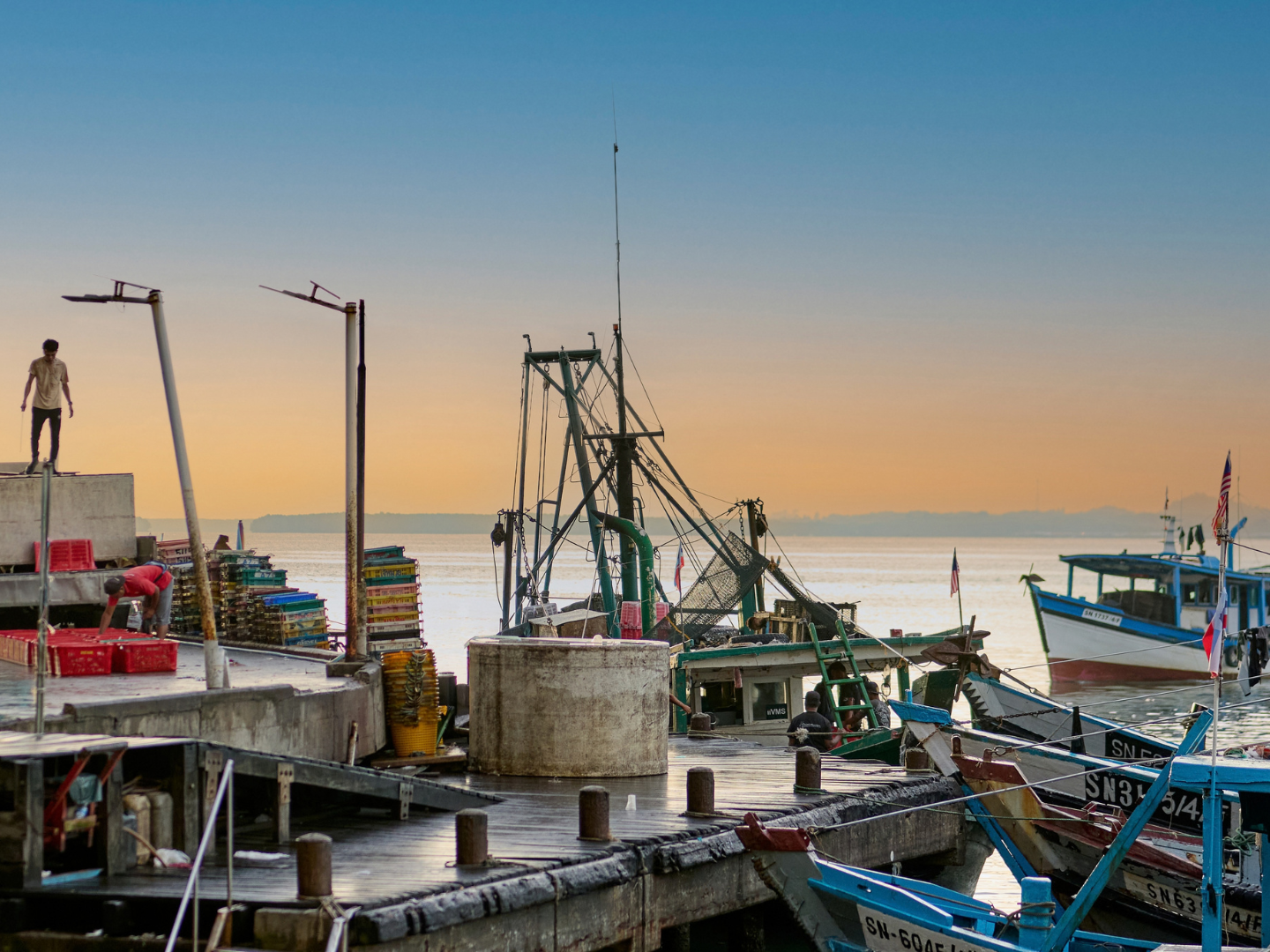
Sandakan is a coastal city on Sabah’s east coast, low-rise and weathered in places, its harbour lined with fishing boats and its older streets still carrying the architectural traces of a Cantonese community that once gave the town its nickname, Little Hong Kong.
Within a few hours’ drive are orangutans, sun bears, proboscis monkeys and one of Borneo’s most important wildlife corridors. There are also old churches, Chinese temples, colonial houses and a market that begins work while most of us are still asleep. Three nights and four days gave me enough time to move between these worlds, although they rarely felt as separate as a map suggests.
The Town by the Water
The AirAsia flight from Kuala Lumpur takes a little over three hours, which still feels slightly strange to someone from the peninsula. Bangkok is closer, Bali is roughly comparable, and both deliver the psychological sensation of having gone somewhere else. On the other hand, Sandakan takes longer to reach and remains within Malaysia, yet the distance becomes apparent almost immediately after landing. It was only after arriving that I began to understand how many versions of Sandakan exist within its borders.
A frequent visitor to Sandakan shared a little trick to make the journey feel like you’re going somewhere else: bring your passport along, even if you’re a Malaysian, get it stamped at immigration and it’s like you’ve crossed into foreign land.

Sandakan Airport is wonderfully compact. We disembarked onto the tarmac, cleared immigration and collected our luggage in what felt like minutes, my mother keeping pace despite the early flight. It was only later, while reading more about the city’s wartime history, that I learned the airfield itself had been constructed by Allied prisoners of war under Japanese occupation. The runway I had just crossed without a second thought had once been laid by forced labour. It is an unsettling thing to learn only after having casually walked across it.
The drive into town took around 25 minutes. The streets were sleepy enough to confirm my initial impression of Sandakan as a small provincial city, although I should probably admit that I use “sleepy” rather liberally for almost anywhere outside Kuala Lumpur. Closer to the waterfront, however, the character changed. The older shophouses, fishing infrastructure and dense low-rise streets reminded me of a less chaotic, more languid Kowloon, which feels like an absurd comparison until you learn how significant the Cantonese community has been to Sandakan’s identity.

Ormond Sandakan sits directly along the waterfront, occupying the upper floors of Sandakan Harbour Mall. Opened in April 2026 after an extensive refurbishment, it is an interesting moment in the town’s development. The public spaces have already been given the Ormond treatment, with dark timber, brass, warm lighting and artwork curated by Liza Ho of OurArt Projects and The Back Room. The aesthetic connects it visibly to its sister properties The Chow Kit and The RuMa Hotel in Kuala Lumpur, although the hotel’s physical bones remain those of an older building. Monochrome photographs of Sandakan in the early 1900s line the guest corridors, and the key card holder unfolds into a map of the heritage trail. Inside my suite, the window looked straight down on the Central Market and the fishing boats tied to its docks.

My Deluxe Suite was comfortable without being transformative, with a sunrise-facing corner overlooking the neighbourhood. Some of the furniture still looked as though it had survived several incarnations of the building, and the lighting and fittings occasionally betrayed its previous life. The Ormond Suite upstairs was another proposition altogether: 125 square metres of pale timber, carpeting and new furniture, with a distinctly Japandi sensibility. It made me understand the long game: when every room eventually reaches that standard, the property will be hard to argue with, and until then the hotel sits somewhere between what the building was and what it wants to become.
What I liked most about the Ormond was where it placed me. The old town was outside the front door, the Central Market was practically next door, and the road towards Sepilok, arranged through Sepilok Tropical Wildlife Adventure at the same front desk, began from the same lobby where we checked in. At sunset, the infinity pool at Bayu seemed to dissolve into Sandakan Harbour, the mountains beyond turning increasingly blue as the sky changed colour.


The food at Ormond was consistently better than I expected. At Rasa, Sabahan ingredients ran through everything on the table, where the tuna hinava, cucur udang and pennywort salad with latok-latok (sea grapes) were the dishes I still think about today. The daily breakfast buffet at Rise became a small ritual of its own and the reason I never slept in. Pietro, the hotel’s Mediterranean grill, was not yet open when I had a preview lunch there, a casual coastal menu cooked over a Josper, and the gambas al ajillo arrived with prawns the size of a fist and never nearly enough bread to mop up the oil. With a few tweaks, it could become a dining destination in its own right.
Even the bar had a local point of view. Osmund, a Sabahan bartender who spent over a decade in Kuala Lumpur before returning home, served me his Botanical Borneo made from rum infused with torch ginger and lemongrass, accented with banana leaf and passionfruit. The herbaceous heat arrived first, the passionfruit sweetness a beat behind it, and drinking it while fishing boats moved below in the dark felt like the right way to end the day.

The service had its own Sabah tempo too, friendlier and more relaxed than the hurried efficiency I am accustomed to in Kuala Lumpur, occasionally bordering on leisurely. Several of the staff told me that hotel work was their first experience of looking after guests over several days, and some had come from retail or F&B, where the interaction tends to begin and end with a transaction. Here, they were learning how to remember a guest, anticipate a request and make someone feel looked after, and the learning curve was oddly endearing to watch. Sharul at the front office told me that this was his first job in a hotel, which I would never have guessed from the ease of it. In any case, there is little else in Sandakan that competes with the Ormond.
READ ALSO: Ormond Sandakan Review: A Tale of The Wild & The Restored
Mornings Around the Harbour
Sandakan Central Market begins its day much earlier than most visitors do. I walked the ground floor carefully, the tiles slick underfoot, past sellers and fishermen in rubber boots and stalls of oceanic treasures, from fishes I knew to molluscs I hardly ever see back home. What caught my eye were the rows and rows of latok-latok, or sea grapes, little green jewels clustered together in bunches. They burst with a briny pop that makes them feel like vegan caviar, and suddenly the ingredient I had been eating at Rasa was everywhere.


It is a working market with all the scents and scenes, not a sanitised attraction, and the atmosphere comes with everything that implies. Upstairs, the Pasar Gantung or “Hanging Market”, named for how clothes are hung from the ceiling and walls, is filled with dried seafood, snacks and local products, including Sabah pearls. Nothing had been dressed up for the visitor. The market was carrying on with its day, seafood arriving, sellers working, people buying things they presumably had every intention of eating.
Sandakan was a port city before it was a wildlife destination, its prosperity tied to timber, fishing and maritime trade, and the stalls downstairs are still keeping the hours of that older town. Chinese communities, Cantonese migrants above all, became deeply embedded in the city’s commercial life, leaving an imprint that remains visible in its food and architecture. Old-school kopitiams still provide a good way into that history. Named for its saucer-like appearance, the UFO tart is a quintessentially Sandakan form of snack diplomacy: fluffy sponge, custard filling and a meringue that looks faintly extraterrestrial, washed down with an inky cup of kopi. The meringue leans cloyingly sweet, in the way only meringue really can, and there is nothing revolutionary about putting pastry, custard and whipped sugar together. Yet there is a local charm to Sandakan having claimed this strange little flying saucer as its own.
The Cantonese influence becomes even more pronounced around Sim Sim Water Village, a settlement raised on stilts above the sea, visible from my suite’s picture window. More than one local pointed me toward its numbered walkways, known as bridges, as the way into some of Sandakan’s most enduring Chinese culinary traditions and the freshest seafood. The 7th Bridge is known best for its spring noodles and century egg dumplings that apparently sell out before ten. Perhaps next time then.

The relationship with the sea is visible almost everywhere, despite there being no great beaches framing the city. Instead, roads hang off the edge of land and sea, with houses and commercial buildings standing on whatever ground the coastline permits. From Ormond’s upper floors, I could see Central Market below, fishing boats moving across the harbour and Sim Sim stretching out beyond them.
Living in the Past
The Sandakan Memorial Park is located close to the airport, on the grounds of the former prisoner-of-war camp just beyond the old town. It is a beautiful place, which initially felt incongruous given what happened there. Trees and tropical vegetation now thrive on much of the site. Remnants of the camp remain among the greenery as artefacts, while a memorial obelisk stands where a large tree once marked the grounds.
The Japanese occupation of Sandakan brought thousands of Australian and British prisoners of war into captivity. They were forced into labour, including the construction of the airfield where we had landed, and were subjected to severe deprivation and abuse. When word of their treatment began reaching outside authorities, the camp was destroyed and the prisoners were marched towards Ranau in a series of journeys that became known as the Sandakan Death Marches. Only a small number survived, and those survivors did so under extraordinary circumstances.

The harrowing history had been difficult for the town to confront for decades. Robert, who has spent some sixteen years guiding for Sepilok Tropical Wildlife Adventure across both the heritage trail and the wildlife excursions beyond it, told us that local reticence around the history eventually gave way to investigation and public documentation. The visitor centre now provides the context that the landscape itself cannot. Photographs, documents and artefacts put individual lives back into an account that can otherwise become overwhelmingly numerical.
For something with less weight, the heritage trail led me next to the Agnes Keith House at the top of Jalan Astana hill. The reconstructed house was once home to author Agnes Keith and her husband, Henry George Keith, also known as Harry, during the British colonial period. Harry was a forester and plant collector whose work took him throughout North Borneo, including his association with the discovery of Rafflesia keithii. Agnes, meanwhile, became the better-known literary chronicler of the territory through books including Land Below the Wind, her account of life in North Borneo before the Second World War.

The house gives that period a domestic scale. After the sombre weight of the memorial park, I was suddenly looking at furniture, books, household objects and the architecture of an ordinary home from another era. Agnes Keith’s Sandakan was a place of domestic routines and colonial administration, of gardens and servants and evenings at home, all in the same territory whose landscape she would later make familiar to her readers far beyond North Borneo. Perhaps that is the point of a house museum: restoring the small, mundane details that disappear when history becomes dates and wars. A kerosene refrigerator, revolutionary at the time, caught my eye and Robert shared a cute story about how they introduced one such refrigerator to the indigenous peoples inland, who comically had ice cream before most city folk did.
The English Tea House beside the house is an easy place to continue that mood. Its afternoon tea sets cost little for two and came with some excellent scones, large, flaky and buttery, with proper clotted cream. There were tables set beneath a large mango tree and views across Sandakan Bay, a different vantage point from the one in my suite. After the weight of the memorial park, it felt almost wonderfully frivolous to have a very good scone on a sunny morning out.

St Michael’s and All Angels Church provides another glimpse of the old city. Established in the late nineteenth century, it is among the oldest surviving churches in Malaysia and escaped major destruction during the wartime bombing that devastated much of Sandakan.
The church had already emptied by the time we arrived. Inside, the long nave was almost completely still, and walking through those hallowed halls while learning about the stories represented in the stained glass was considerably more interesting than I had expected. Biblical imagery sits alongside references that connect the windows to local history, creating an unusual conversation between scripture and the place outside.

Meanwhile, Puu Jih Shih Temple is perched above the city with panoramic views over Sandakan Bay. Ask around town and someone will tell you the 1987 temple is the largest Chinese temple in Sandakan, with elaborate dragon sculptures, gilded Buddhist figures and a view that makes the climb worthwhile. It also has the sort of visual excess that would not look remotely out of place on a television travel programme, which may explain why it once appeared as a checkpoint on The Amazing Race.
From the memorial park to the temple, Sandakan’s history refuses to conform to one period of time. You move between wartime occupation, British colonial life, Chinese migration and the present-day city within a handful of kilometres.

Into the Forest
Disclaimer: I am far from the archetypal Sandakan traveller. Wildlife excursions are not usually the first thing that comes to mind when I decide where to go. I have nothing against animals, forests or national parks—in fact I love them all. They just do not exert the same gravitational pull on me as food, hotels, architecture or old cities, though Sandakan made a fairly convincing “when in Rome” case.
Robert had taken us into the forest the day before, the same guide from Sepilok Tropical Wildlife Adventure who had walked us through the memorial park, though the terrain that day was trees and water. At the Sepilok Orangutan Rehabilitation Centre, he explained that the orangutans are often introduced using the local term sepupu, meaning cousin, symbolising the closeness between the man of the city and the man of the forest. The centre rehabilitates orphaned, displaced and rescued orangutans, many of whom arrive because of habitat loss, logging or the illegal wildlife trade.

Then an orangutan and her baby appeared on the railing directly in front of us. We were told not to look her in the eye and simply to keep walking. Apparently, prolonged eye contact could be interpreted as a threat, which is useful information to receive when you are suddenly standing within arm’s reach of a several-dozen-kilogram primate.
So we walked past her, trying very hard to appear casual, while her baby clung to her chest and then her back as she moved, completely unconcerned by the small procession of humans trying not to offend her.
The feeding platforms attract the animals at scheduled times, but the experience is not really about watching them perform. From the observation room, we watched the orangutans compete with monkeys for the fruit and vegetables provided by the rangers. The monkeys were faster, smaller and considerably more shameless, darting around to grab whatever they could. The orangutans looked almost lazy by comparison, all lanky limbs and slow movements, until one swung from rope to rope with startling ease, a baby hanging onto its mother for dear life. Each one makes a nest of branches and leaves and abandons it after a single night’s use.

The Bornean Sun Bear Conservation Centre, founded and led by Dr Wong Siew Te, across the road was a different kind of encounter. The sun bear is the world’s smallest bear species, recognisable by a chest marking that differs from bear to bear, as individual as a fingerprint. From the elevated boardwalks, we watched one climbing through the trees while macaques moved around nearby with the confidence of animals who have become aware of how much they can get away with. I didn’t have time on this trip to visit the Rainforest Discovery Centre, a short way from both, where a 620-metre canopy walkway rises up to 27 metres above the forest floor and the evening programmes go looking for red giant flying squirrels.

The key draw of Sandakan makes itself most known on the Kinabatangan River, where we drove for roughly two hours to Bilit, a small riverside settlement where lodges and tour operations have become an important part of the local economy. Once on the boat, the intensity of the Sabah sun became almost comical. Sitting still was brutal. People were turning red beneath their hats and sunscreen. Once the boat accelerated and cut through the tropical air, the wind made the heat bearable, and suddenly the river became the easiest place in the world to sit for a couple of hours.
Proboscis monkeys appeared along the banks, often in groups, while macaques moved through areas where human activity has become part of their environment. A saltwater crocodile surfaced unexpectedly close to the boat, drawing a collective silence that photographs rarely capture.
Then there were the elephants, or, more accurately, the evidence of them. Robert pointed towards stretches of sugarcane where the vegetation had been broken apart, explaining that pygmy elephants often pass through the riverbanks to drink. We watched the gaps in the plants and the disturbed vegetation, knowing an elephant had probably been there not long before us. We never saw one ourselves, which somehow made me pay more attention to everything else. The broken sugarcane, the calls from the trees, the ripples disappearing into the water, the marks left by animals that had passed through without posing for a picture. For once, the absence of the star attraction made the experience more interesting.


The other side of the Kinabatangan is harder to ignore. Plantation land appears repeatedly along the journey, sometimes directly beside areas of remaining forest. The river is an extraordinary wildlife corridor, but it is also part of a landscape worked over by agriculture and human settlement. The Orang Sungai, literally “river people”, have lived along these waterways for generations, and the lodges and tourism operations now provide employment for communities in the area.
It was striking how international the wildlife tourism audience was. On the river, almost every other boat seemed to be filled with European or Australian visitors, most of them sitting beneath hats and sunscreen while turning increasingly red under the equatorial sun. For many of them, Sandakan is already a destination in its own right. For Malaysian travellers, especially those already used to island-hopping around the region, it requires a different calculation. The wildlife is the draw, and once you accept that, the effort starts making sense. For a fully nature-centric experience, I’d opt to put a night or three at one of the riverside lodges like Bilit Adventure Lodge to be closer to the wildlife both by day and by night.
Returning from the Kinabatangan that evening tired, sunburnt and covered in the residue of a long hot day, I took a nice, long, hot shower, and the water pressure was so ferocious it felt like standing beneath the controlled release of a containment dam. I have rarely appreciated indoor plumbing as profoundly as I did then. Picking up the in-room phone to order room service for what seemed like the first time in my life, a club sandwich, coastal fry basket and a simple rice, made me waver in my conviction that restaurant dining is superior. The cart that arrived opened into a dressed table beside the window, and the sight of dinner assembling itself without me needing to put on a dinner-ready outfit felt disproportionately magnificent.

The Sandakan I Left
Sandakan had somehow managed to give me a memorial, a meringue-topped tart, a water village I only ever saw from a distance, a colonial tea house, an orangutan encounter, an elephant I never saw and one of the greatest showers of my recent life. There was, of course, more. Locals kept steering me towards two places that would require another couple of days: Gomantong Caves, where bats, swiftlets and edible bird’s nests occupy Sabah’s largest cave complex, and Turtle Islands Park, out to sea, where turtles come ashore to nest in season.
Back in the old town, the fishing boats were still moving across the harbour beneath my window. The Central Market would begin again before sunrise. The runway that forced labour had laid was still taking its flights. Somewhere beyond the city, the Kinabatangan was continuing its slow passage through plantations and forest, while the orangutans at Sepilok were settling into nests they would abandon and rebuild the following day.
By the time I left, I was still thinking about that tear at the memorial park, but also about the Kinabatangan wind, the enormous prawns at dinner and the strange pleasure of watching a landscape for an elephant that never appeared. Sandakan had too many lives to reduce to a single story, which is probably the best problem a traveller can have.
When You Go

- Getting there. AirAsia and Malaysia Airlines fly direct from Kuala Lumpur, a little over three hours. From Kota Kinabalu, AirAsia covers the 45-minute hop several times daily, with Firefly and Batik Air as smaller alternatives.
- When to go. Sandakan’s wet season runs roughly November through February. March through October is the more favourable window, with August and September often cited as the driest stretch.
- Getting around. The old town and waterfront are walkable, and Grab covers everything else nearby. Sepilok, the Rainforest Discovery Centre, and the Kinabatangan sit well outside town and are best reached through an arranged transfer or tour.
- Where to stay. Ormond Sandakan, on the waterfront, within reach of both the old town and the road inland.
- Entry fees. Sepilok Orangutan Rehabilitation Centre: RM30 foreign / RM5 Malaysian. Bornean Sun Bear Conservation Centre: RM50 foreign / RM10 Malaysian.
- How long to stay. Three days covers the essentials, one for the old town, one for the rainforest and river, one for the heritage trail. Four or five leaves room for Gomantong or Turtle Islands.
- Book excursions through Ormond Sandakan’s front desk or directly with Sepilok Tropical Wildlife Adventure, who run both the wildlife circuit and the heritage trail.
Images courtesy of Ormond Sandakan, Sabah Tourism, and Bryan Yap for Nacre.
Editorial Note: This story was produced following a hosted stay at Ormond Sandakan and hosted excursions with Sepilok Tropical Wildlife Adventure, with flights courtesy of AirAsia. Nacre retains full editorial independence, and all reflections are the author’s own.
From the table to the world beyond, Nacre brings you dining, travel, and lifestyle experiences worth savouring. Explore more with us on Instagram (@nacre.asia).

Leave a Reply