
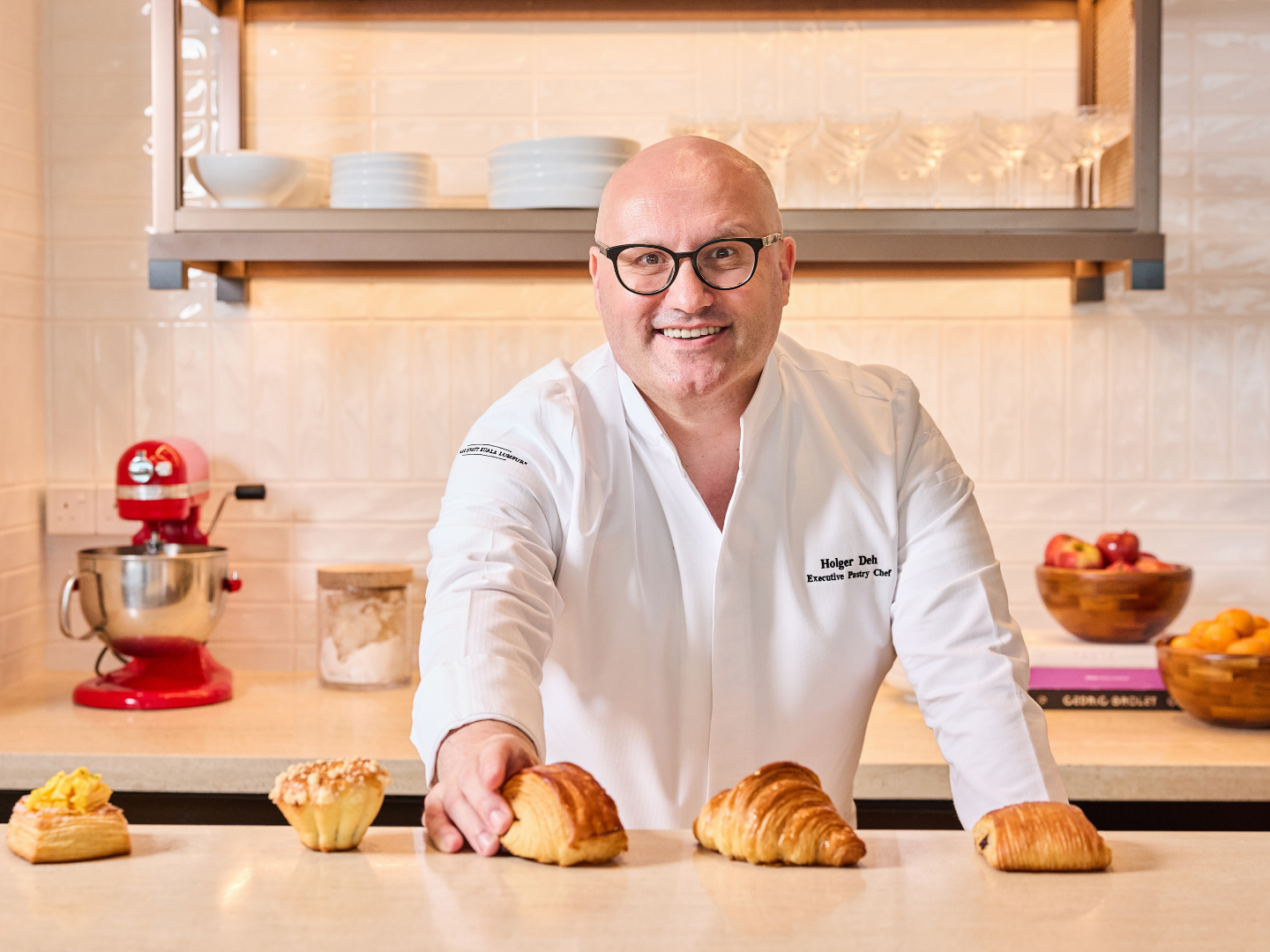
One year in, the Executive Pastry Chef talks restraint over novelty, chocolate designed with a purpose, the possibilities of plant-based pâtisserie, and what Malaysian cacao still needs to find its place on the world stage.

Chef Holger Deh arrived at Park Hyatt Kuala Lumpur with a career that had taken him from Michelin-starred kitchens in Europe to a long tenure as Area Executive Pastry Chef for Asia at Rosewood, where Butterfly Patisserie in Hong Kong became a destination in its own right. He had already developed his own custom couverture through Cacao Barry’s Or Noir programme in 2012, and during the pandemic stepped away from hotel kitchens to co- found Essentia, a plant-based pâtisserie, with a partner. Today, those different strands of his career now meet under one spire.
A year into Park Hyatt Kuala Lumpur, we speak to Chef Holger about what that first year has taught him, the ideas he left behind along the way, and where he sees pastry going next, from chocolate designed with a purpose to plant-based patisserie and Malaysia’s still-developing identity as a fine-cacao origin.
“Unique Is Easy. Meaningful Is Much Harder.”
When you were building Park Hyatt Kuala Lumpur’s pastry programme, what’s one idea you initially thought would work here but ultimately discarded?
One idea I chose not to pursue was a dedicated chocolate trolley alongside our dessert trolley during Afternoon Tea. On paper it sounded exciting. In reality, it was simply too much, adding quantity over value.
And what have you become more certain of over the first year?
One area I hoped to develop even further was plant-based pastry. It aligns naturally with Halal requirements, accommodates a wide range of dietary preferences, and is a more sustainable direction for the future. I still believe strongly in it, but over the past year I have become more convinced that guests should never feel they are choosing a compromise. The focus must always be flavour first.
What I have become more certain of is actually something I have gradually learned throughout my career: luxury is not about offering more. It is about offering the right things and executing them exceptionally. I would rather create one dessert that guests remember and return for, than five desserts they forget.

More than a decade ago, you developed your own customised chocolate through Cacao Barry’s Or Noir programme. Now Park Hyatt Kuala Lumpur has the Holger Deh 71%, made with Valrhona. How has your idea of a signature chocolate evolved between those two projects?
The first time I created a customised chocolate, I was driven by curiosity. I wanted to create something unique. This time, I was driven by purpose. The Holger Deh 71% was never intended to be a marketing exercise or simply a chocolate carrying my name.
I wanted to create something that reflected what we are creating at Park Hyatt Kuala Lumpur. Something elegant, precise, and memorable without being loud. Over the years, I have become less interested in creating something just to be different and more interested in creating something meaningful. Unique is easy. Meaningful is much harder.
What were you specifically asking Valrhona for?
Complexity, but also balance. I wanted a chocolate that revealed itself slowly, with depth, spice, roasted notes, and enough length on the palate to work alongside fine spirits without overwhelming them.
At the formulation level, what does “designed for pairing” actually mean?
Most people think about chocolate by itself. I was thinking about what happens after. The first taste matters, but so does what remains on the palate ten or fifteen seconds later. That lingering finish is where the conversation between the chocolate and the drink happens. If the chocolate is too powerful, it dominates the spirit; If it is too delicate, it disappears entirely. That balance took countless tastings.

If you tasted the finished chocolate blind today, is there anything you would change?
I would still be very happy with it. Every chef wants to keep improving, and I do not think that feeling ever disappears. But that constant pursuit of perfection is exactly why the chocolate exists in the first place. The day I stop wanting to improve something is probably the day I should stop being a pastry chef.
More than a decade before the Valrhona collaboration, Cacao Barry’s Or Noir programme had already given Chef Holger the opportunity to develop chocolate around his own desired flavour profile. His relationship with his own name on a couverture therefore predates the one now sitting beneath Cacao’s counter lights.
“I Am Not Interested In Reinventing The Mille Feuille. I Am Interested In Perfecting It.”
There is a dessert at Park Lounge that has become larger than the menu it sits on. I have returned more than once just for the Penang Vanilla Mille Feuille, and brought people along each time purely so they could see for themselves what draws me back.

Which creation has surprised you most in the way guests have responded to it?
Without question, the Penang Vanilla Mille Feuille. I always believed it was a strong dessert, but what surprised me was how quickly it became part of the identity of Park Lounge. Guests return for it. They recommend it to friends. They post about it. It has become much bigger than I ever anticipated.
What pleases me most is that its success validates something I have believed for a long time: simple does not mean easy. When guests respond so strongly to something that appears so simple, it reinforces my belief that craftsmanship still resonates.
What keeps bringing you back to something so classical?
As a younger chef, I often wanted to add more, more flavours, more components, more techniques. Over the years I have gone in the opposite direction. The Mille Feuille we serve today is the result of simplifying again and again until only the essentials remained. That is what makes classical desserts so fascinating. They leave nowhere to hide. Every layer, every texture, every detail must be right.
How far can you change a mille feuille before it stops being one?
You can change the flavour, the filling, the presentation, even whether it is sweet or savoury. The moment you lose the balance between delicate pastry, cream, and texture, you lose its soul. I am not interested in reinventing the Mille Feuille. I am interested in perfecting it.
Has experience made you better at knowing what to remove?
Absolutely. When I was younger, I thought a great dessert showed how much you could do. Today, I think a great dessert shows how much you can leave out. Complexity is easy, but clarity is difficult. Anyone can add another component, another texture, another garnish. Knowing what does not belong takes much more confidence.
What is one current pastry trend you would be happy to see less of?
Desserts designed primarily for social media. There is nothing wrong with creating a visual moment, but a dessert should be remembered for its flavour long after the photograph is forgotten.
When I create a dessert, I do not start by asking whether it will look good on camera. I start by asking a much simpler question: would I come back for it? If the answer is no, I am not finished yet. The best compliment I can receive is not that someone shared it online, but that they came back and ordered it again.
“The Ritual Creates A Moment, But The Chocolate Still Has To Do The Hard Work”
The sound arrives before the chocolate does. A short, dry crack cuts across Cacao as a chisel meets the 19-kilogram block of Holger Deh 71% behind the counter and heads turn. What began as a way of serving the hotel’s signature chocolate has taken on something of a ritual around it.

Your team creates for very different settings, from Park Lounge and retail to Merdeka Grill and Cacao. Where do the demands of these outlets pull you in different directions?
The concepts are very different. At Park Lounge, Afternoon Tea is the heart of the experience, and we focus heavily on storytelling through Malaysian influences and forgotten recipes. At Cacao, the conversation revolves around chocolate and the craftsmanship behind it. Merdeka Grill takes a more classical approach, with desserts designed to complement the dining experience rather than compete with it. Retail is perhaps the most challenging, because guests are inviting a piece of our work into their homes. That requires a different mindset again.
What connects all of them beneath the surface?
Restraint. We are not trying to create the largest selection or the most elaborate desserts. We focus on quality, consistency, and products that guests genuinely want to experience again.
If there is a recognisable pastry identity at Park Hyatt Kuala Lumpur, I hope it is this: thoughtful craftsmanship, clear flavours, and an understanding that less is often more.

At Cacao, that 19-kilogram block gets chiselled in front of guests every night, and the sound alone turns heads across the bar. Where is the line between creating an experience around chocolate and turning it into a gimmick?
The line is very simple. If the experience disappears and the product is no longer interesting, then it was probably a gimmick. If the experience helps guests appreciate something exceptional, then it has value.
So what was the intention behind the block and chisel specifically?
They were never intended as theatre for its own sake. Guests see the texture, hear the sound, smell the aromas, and become more engaged with the product. We live in a world where food is consumed quickly, often through a screen before it is even tasted. Chocolate deserves more respect than that. The ritual creates a moment, but the chocolate still has to do the hard work.
“Where Does It Come From?”
If Cacao asks guests to pay closer attention to chocolate, Chef Holger also thinks the industry has given them an incomplete vocabulary for understanding it.
What do guests still commonly misunderstand about fine chocolate?
The biggest misconception is that cacao percentage equals quality. It doesn’t. A 90% chocolate can be terrible, and a 65% chocolate can be extraordinary. The percentage only tells you how much cacao is present, but nothing about the genetics of the cacao—where it was grown, how it was fermented, how it was roasted, or how skilled the chocolatier was.
Why hasn’t chocolate developed the same consumer literacy around provenance that we now see with coffee or wine?
I find it fascinating that consumers have become incredibly knowledgeable about coffee and wine. They talk about origin, producer, processing methods and terroir. Chocolate deserves exactly the same conversation. The future of fine chocolate is not educating guests to ask “how dark is it?” The future is educating guests to ask “where does it come from?“

Do you see a future where chocolate becomes increasingly purpose-built, formulated for a specific spirit or dessert rather than chosen off a shelf?
Without question. I think we are only at the beginning of that journey. Historically, chefs selected from existing couvertures and adapted recipes around them. What excites me is the opposite approach, starting with the desired experience and developing a chocolate specifically for that purpose.
A chocolate designed for whisky should not necessarily be the same chocolate designed for pastry, the same way a sommelier would not pair every dish with the same wine. Purpose-built chocolate allows us to create experiences that cannot be replicated elsewhere.
“We Only Scratched The Surface”
In July, I sat through an evening at Cacao Mixology & Chocolate for an experience less like dessert with drinks alongside, and more like a tasting menu spotlighting chocolate in myriad forms.
The Journey of Malaysian Cacao took me through five courses named Aroma, Discovery, Terroir, Dialogue and Signature, each pairing a distinct Malaysian origin: Kota Marudu in Sabah, Perak, Bario in Sarawak, Semai in Pahang, against a different register of drink, before closing on the signature Holger Deh 71%. At the time, it felt like a test of something bigger. Chef Holger’s answers now confirm that instinct.

When you and Wei Lung developed The Journey of Malaysian Cacao, was it the pastry or the drink that led?
Neither. The moment one side starts leading, the collaboration becomes less interesting. We approached the concept with a simple question: how can chocolate tell a story?
Sometimes that story was expressed first through a dessert, sometimes through a cocktail, sometimes through both at once. The strongest moments came when neither of us was protecting our own discipline.
Where did the two of you disagree?
More often than people would probably expect, and that’s exactly why it worked. A bartender experiences flavour through aroma and balance in the glass. A pastry chef thinks first about structure and texture over multiple bites. Those perspectives do not always align immediately. But we never asked whose idea wins. We asked which version creates the better experience.
What did that first evening teach you?
That guests are far more curious than we sometimes assume. People arrived expecting chocolate. What surprised me was how interested they became in fermentation, sourcing, farming and flavour development. They wanted to understand the story behind the chocolate, not just consume it.

What would you change or push further next time?
I would go even deeper into Malaysian cacao. The country has extraordinary ingredients and talented producers, and there are still many stories that deserve to be told. To be honest, I feel we only scratched the surface.
Could this experience become part of Cacao’s identity?
I think it should. Luxury today is moving away from excess and towards experiences that feel personal and difficult to replicate. The response showed us that guests want discovery, interaction, a story. It is not finished yet, but I believe there is significant potential to develop it into something that becomes synonymous with the venue.
Chef Holger’s ambition at Park Hyatt Kuala Lumpur sits within a wider moment for Malaysian cacao. The July experience drew on origins from across the country through Chocolate Concierge, placing the farmers, fermentation and provenance behind the cacao into the conversation alongside what eventually appeared on the plate and in the glass.
“The Challenge Is Creating Desire.”
Chocolate is not the only part of pastry that has led Chef Holger to question the conventions of his craft. Years before Park Hyatt Kuala Lumpur, another project had already required him to dismantle them almost ingredient by ingredient.
Essentia was ahead of its time in some ways. What made plant-based pâtisserie hard to sell then?
The challenge was never creating an option. The challenge was creating desire. Many plant-based dishes are still designed around what they cannot have rather than around what makes them special. Guests should choose a dish because it is delicious, not because they have dietary restrictions. When somebody orders a dessert, loves it, and only afterwards discovers that it is plant-based, we have succeeded.

Did that experience change how you approach conventional pastry?
Completely. When you remove butter, cream, eggs and gelatin, you are forced to understand ingredients at a much deeper level. You stop relying on tradition and start relying on knowledge. Ironically, it made me a stronger classical pastry chef. It taught me to question every ingredient and ask whether it is there because it is necessary, or simply because that is how it has always been done.
Is there anything traditional pâtisserie can still do that plant-based cannot?
There are still certain textures where traditional pastry has an advantage, and any honest pastry chef would admit that. But I think we sometimes ask the wrong questions. Plant-based pastry should not spend its life trying to become traditional pastry. It should become the best version of itself. If I launched Essentia today, I would speak less about what is missing and more about what is possible.
“The Industry Does Not Need More Desserts. It Needs Better Ones.”
Malaysia’s place in the chocolate supply chain is already considerably larger than its international reputation as a cacao origin might suggest. Cocoa grinding reached 90,849 tonnes in the second quarter of 2026, accounting for approximately 40 per cent of Asia’s total, according to figures reported by Malay Mail from the Cocoa Association of Asia and Malaysian Cocoa Board.
For Chef Holger, the more compelling question is what comes next: what would it take for Malaysian cacao to develop an identity recognised beyond Malaysia?

You worked in Malaysia before the current wave of interest in local cacao. What has changed the most since then?
The progress has been remarkable. When I first arrived here, there were already passionate people producing excellent cacao, but they lacked visibility and recognition. Today there is real ambition throughout the industry, with farmers, producers, chocolatiers and chefs all pushing quality forward.
Where is the biggest opportunity now?
Consistency and identity. When people think about chocolate origins, they immediately think of Ecuador, Madagascar, Venezuela. Malaysia deserves to stand in that conversation. The quality exists. The next challenge is defining what makes Malaysian cacao uniquely Malaysian. That story is still being written.
What is the problem in pastry or chocolate you haven’t solved yet, but most want to?
The industry has become very good at creating more, more techniques, more components, more visual impact, more choices. What interests me now is creating meaning. The question I ask myself today is not how to make a dessert bigger or more expensive.
The question is how to make it memorable, how to create something that reflects a place, tells a story, respects the ingredient, and leaves a lasting impression. The industry does not need more desserts. It needs better ones. That pursuit will keep me busy for the rest of my career.
Chef Holger Deh is the Executive Pastry Chef of Park Hyatt Kuala Lumpur. His custom Valrhona blend, Holger Deh 71%, is exclusive to the hotel and can be found at Cacao Mixology & Chocolate, Park Lounge, and Bakery Bar. Selected images courtesy of Park Hyatt Kuala Lumpur.
Learn more at parkhyattkualalumpur.com / @parkhyatt_kl
From the table to the world beyond, Nacre brings you dining, travel, and lifestyle experiences worth savouring. Explore more with us on Instagram (@nacre.asia).

Leave a Reply