
An evening at JHOL Kuala Lumpur moves across nine coastal states of India, from the Konkan coast to the Bay of Bengal and back again, guided by kitchen lineage that stretches from Udupi to New York to Bangkok, and now to Mont Kiara.

A hand-painted map of old India greets me at the door. It is rendered in the style of cartographers circa 1970, when coastlines were still drawn by hand and the interior lay in softer detail. Calicut to the west, Chettinad at the southern tip, the Konkan running north, the Bay of Bengal to the east. A member of the team walks us through it—tracing the seven-and-a-half thousand kilometres of Indian coast with a finger, naming the nine states whose fishing villages, temple kitchens, and colonial ports have, between them, shaped one of the most stylistically diverse culinary traditions in the world. The map is not a decorative gesture. It is JHOL Kuala Lumpur‘s menu, redrawn.
The Restaurant Behind the Menu

JHOL Kuala Lumpur opened its doors in May 2025, on the ground floor of THE MET Corporate Towers in Mont Kiara, a new development that also houses numerous dining outlets. Within JHOL’s own footprint sit two sibling concepts: Chola, the cocktail bar, and Mintsha, the shisha lounge. Together, the trio holds a full evening — aperitif, dinner, digestif.
The restaurant is the Malaysian sister to the Michelin Guide-listed JHOL Bangkok, founded by chef-patron Hari Nayak. Nayak is based in New York but raised in Udupi, a small coastal town in Karnataka whose culinary culture forms the identity of the entire project. He trained at the Culinary Institute of America and began his career at Daniel in New York under Daniel Boulud, later working alongside Marcus Samuelsson and Albert Adrià. He is also the author of seven cookbooks, including Modern Indian Cooking.
Brought to Malaysia under Clifftop Group Asia, led by founder and CEO Shyam Thakur, the kitchen at JHOL KL is helmed by Executive Chef Gaurav Gupta, who opened the Bangkok flagship alongside Nayak nearly a decade ago. Gupta is supported by restaurant manager and sommelier Rohait Matto who leads the service team. The KL kitchen is not an interpretation of Bangkok from a distance but of the same lineage, relocated.

JHOL enters a city whose Indian fine-dining landscape is rapidly on the rise. NADODI continues to define the modern nomadic Tamil-Sri Lankan tasting menu at the Four Seasons, with Jwala and JHOL as the notable new arrivals, each working in a different register. Coast by Kayra is its closest comparison—a coastal Indian concept with both tasting and à la carte formats. The late FLOUR, a pioneering institution whose legacy continues to shape how KL thinks about Indian fine dining, closed permanently last year.
READ ALSO: Coast by Kayra Review: Voyage to Keralan Shores
The Room

The facade is all glass within The MET’s ground-floor lobby. The entrance is a traditional Indian door set into it—one of several small dissonances the restaurant stages. Beyond the map sits Chola, the cocktail bar, and a stunning spiral staircase that wraps around a column of stacked Bollinger champagne, leading up to private dining rooms on a loft above. The main dining rooms sit deeper in — past the kitchen pass, past a wall of traditional wishing bells where guests tie red ribbons after ringing one, a gentle I was here mark. The space itself is modern and minimal — clean lines, natural materials, unobtrusive Indian artwork — but the small ceremonies of it are unmistakably of the subcontinent.
The wine programme is surreptitiously serious. A glass-walled tasting room sits on the upper loft, its shelves carrying a wide selection across France, Spain, Italy, Germany, Australia and New Zealand, alongside labels from the United States, Chile and Argentina. A separate premium sommelier selection holds court for those who want to go deeper.
Coast to Coast tasting Menu
We are seated by the window on what is a relatively quiet evening for us. Rohait begins the evening with a glass of Bollinger Special Cuvée—pinot noir, chardonnay, and pinot meunier from Champagne, with a long creamy finish and a whisper of ripe fruit. A flute of bubbles to open a coastal journey. We take our water sparkling.

The tasting is titled Coast to Coast (RM350++ per person). The conceit is literal as the menu traces India’s coastline from west to east—but it is also a restaurant that has itself travelled, from New York to Bangkok to Kuala Lumpur, before it arrived at our table. More than nine Indian states pass through the evening, and more than a few cities beyond.
Prelude

Three delicate bites open the meal, one per coastline. Avocado Acchappam — a Keralan rice-flour rose cookie, lacy and crisp like the honeycomb murukku we know here, cradling a zesty avocado crema punctuated by tamarind, with a light dusting of the house gunpowder, JHOL’s read on milagai podi, the South Indian chili-lentil-sesame blend. Mushroom Dhokla — the spongy Gujarati chickpea-flour cake, crowned with a mushroom mousse infused with winter truffle that melts on the tongue. Crab Urundai — a Tamil-named crab croquette, intensely spiced and finished with exquisite Baeri caviar, served on precise dots of thakalli (tomato) chutney. Three bites, three coastlines. A strong statement of intent.
Starters
The starters move east and west across the map in sequence, each dish anchored to a coast and a tradition. The Kokum Hamachi arrives first — Japanese yellowtail carpaccio cured with kokum, the deep purple-black dried fruit from the Konkan coast, sharply tart with a subtle sweetness and a cooling finish native to its Ayurvedic classification. The fish is meltingly soft, almost disintegrating on the tongue. But the plate carries too many competing voices: the botanical lift of dill oil against the sweetness of passionfruit gel against kokum’s own tartness, with the hamachi’s delicate flesh caught in the middle. The fish becomes the background on its own plate. A dish I want to love more than I do.

We travel east for the Bhapa Maach, and arrive at one of my favourites of the evening. Bhapa translates literally to steamed; maach is fish. A hefty chunk of grouper, marinated in mustard and yoghurt and spices, wrapped in banana leaf and steamed, flakes under pressure and holds all of its moisture. It glistens under spotlight. The mustard carries that particular edge Bengali cooks prize—a low wasabi warmth that rises through the nose rather than the tongue—tempered by a cool daikon raita. A star course.

Here, too, the bread course arrives unannounced. Masala Muska Buns—pillowy white boules, freshly baked, so soft they feel almost sanctimonious when pulled apart. Inside each, a surprise: a warm spiced potato paste, hidden until the tear. Beside them, two compound butters I will remember longer than I would think—a sunset-orange Pav Bhaji one, and a verdant curry leaf butter, both intensely perfumed, both a little salty. Off-menu, unapologetically European in grammar, and threaded into a coastal Indian tasting without needing explanation.

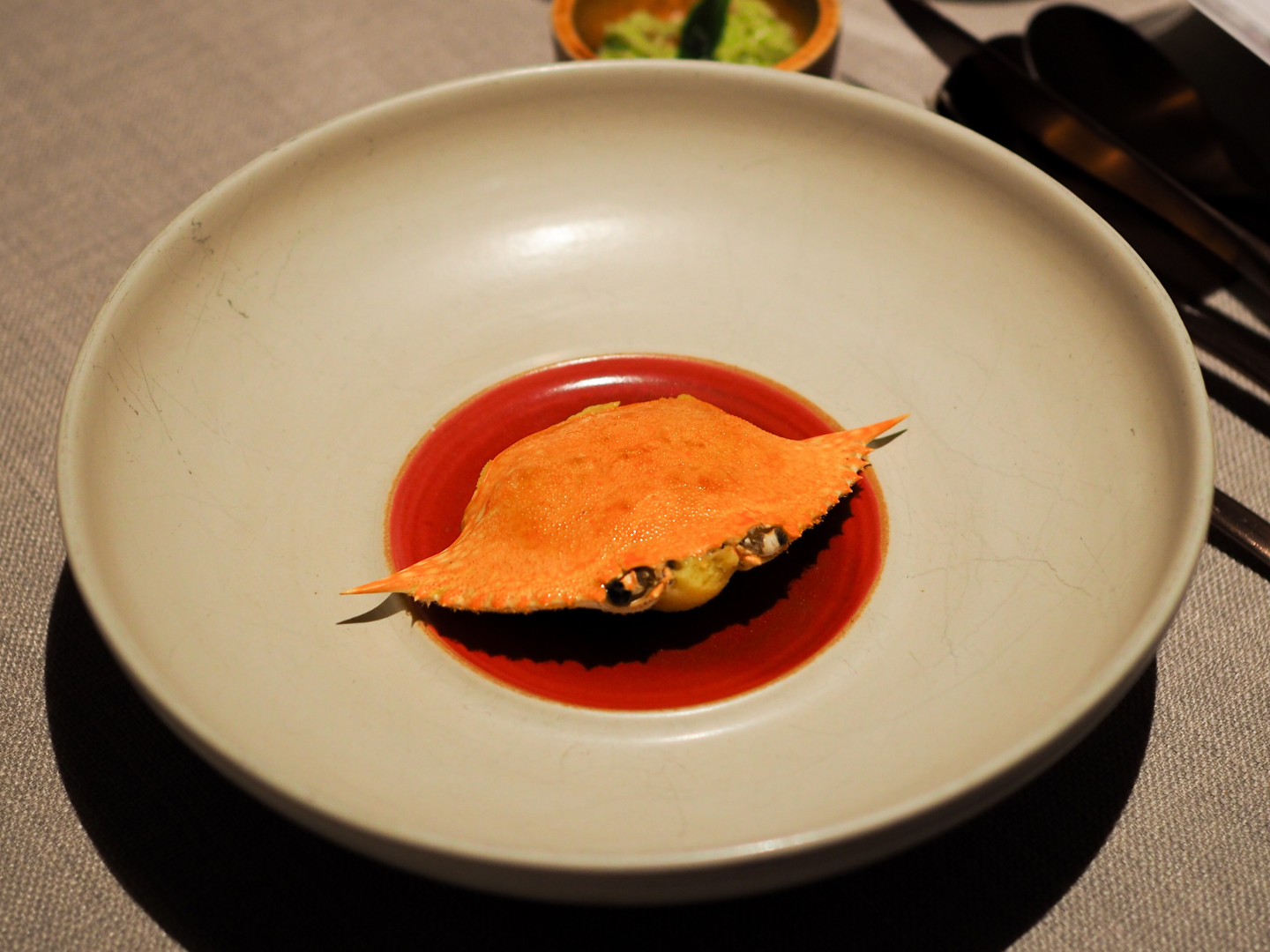
Then the heat rises. The Kundapura Ghee Roast Crab arrives with its shell placed upside down, the reveal built into the plating. Flipping it over uncovers a rust-coloured paste of ghee-roasted crab meat, hidden beneath a Kanchipuram idli—the dense, pepper- and cumin-spiced temple idli with roots at the Varadharaja Perumal temple in Tamil Nadu, a different creature entirely from the soft plain idli most are familiar with. The first thing I catch is the scent of dried chillies and cumin, then the sweetness of crab. Among the spiciest courses of the night, though not heat for its own sake. The coconut and green mango chutney beside it tempers everything. Kundapura is minutes from Nayak’s hometown of Udupi. Imran tells us this is his favourite on the menu, and I understand why.

Finally, the BFC (Berhampur Fried Chicken) is named for a coastal town in Odisha on the east coast. Odisha is among the least-represented coasts in modern Indian fine dining globally; at JHOL, it is a signature across both Kuala Lumpur and Bangkok restaurants. The dish arrives brilliant red and steaming, a deboned chicken wing stuffed with an aromatic chicken mince like a meatball, battered and fried to the utmost precision. It is light where it could easily have been heavy. The fennel slaw is a clean counterpoint; the green Jhol hot sauce—yoghurt, potato, coriander—is unexpected and good with a green acidity that once again mellows the heat of the wing. A staple of the menu, and a definite crowd-pleaser.

Interlude
A palate cleanser: coconut cream sorbet with passionfruit mousse. Palate cleansers tend toward a granita-adjacent iciness; here, the creaminess feels right. A cooling restatement of the coconut that has run, unannounced, beneath most of the preceding courses.

A small aside: the tableware all evening is exceptional. Each course in its own bespoke vessel, in shades of terracotta, stone, or fired ceramic, each piece unique in texture and hand.
The Main Event: Surf ‘N’ Turf

The mains are served family-style, and our table for two is full edge to edge. A whole roasted duck breast, sliced and resting in Kuttanad Mappas curry—the coconut-milk gravy tradition from Kerala’s backwater region, with a likely Portuguese inflection in its etymology. Butter Garlic Grouper in Malabar cashew kurma, nutty and gentle. A steaming bowl of short-grain ghee rice. Flaky Malabar parota. Dense idli. The portions astonish me—I had expected one or two slices of duck per person, and received a whole side of breast for sharing.
The duck eats like steak, cooked to a blush medium and meant to be enjoyed slowly. The rich mappas is best mopped up with the parota. The crisp skin and aromatic fat amplified by the savoury gravy. The grouper is aromatic, though I prefer the steamed fish from earlier. The idli is unremarkable on its own but becomes a splendid vehicle for the gravy. The table becomes a kind of choreography—carb to gravy to protein, repeated and re-sequenced, each round revealing a new register. It is, candidly, a great deal of food.


Rohait pours a 2023 Pascal Jolivet Attitude Pinot Noir from the Loire—bright ruby in the glass, led by red fruit and cherry with a subtle spice on the finish. Dry, light-bodied and food-friendly, it lifts beside the richness of the mappas rather than fighting it.

Desserts
A predessert of Shrikhand—a strained-yoghurt dessert from Gujarat and Maharashtra—is intensely perfumed with saffron, finished with mango gel and chia seeds. We finish with the Apple Chiroti, a flaky Karnatakan pastry dusted with icing sugar, layered with cubes of stewed apple, a dense cheesecake tucked discreetly beneath. Picture a lighter mille-feuille with hidden depth. It is served with a rocher of vanilla-bean ice cream resting on chocolate soil. The chiroti is excellent. The ice cream, on its own, is also excellent. Together, they sit on different registers—the chocolate soil is the note that separates them, because the ice cream alone would have paired beautifully with the pastry in an apple-pie-à-la-mode sense.

On Service
Service through the evening is attentive and quietly literate. Napkins refolded or replaced when I step away. Water glasses never empty. Cutlery refreshed between courses. A proper decrumbing. Finished plates cleared without announcement. Every course arrives with an introduction—an origin, a technique, a small piece of culinary geography. The front of house understands the menu and understands why each dish exists and earns its place in the experience.

Rohait’s two wine choices are part of the same attention to detail. The Bollinger to open, creamy and brioche-led, is a gracious welcome. The Pascal Jolivet Attitude Pinot Noir across the mains is a considered call—a light, red-fruited Loire with enough freshness to stand beside the density of coconut and duck without overwhelming the more delicate notes of the grouper and its cashew kurma. A versatile pour for a family-style course where four flavour registers sit on the table at once.
Final Notes
JHOL KL is several things at once. It is an elegant coastal Indian restaurant in a corporate tower that also lets you finish the evening at a cocktail bar and a shisha lounge without changing rooms. It is a Bangkok concept transplanted with its kitchen leadership intact, which is not the same as a franchise. It is a menu that genuinely travels nine coastlines of India, with the geographic literacy to tell you which one you are on. And it is, in my experience, a room where service and food and setting are calibrated in the same key.
The Coast to Coast tasting is not the only way to eat here. An à la carte menu runs alongside it, and the kitchen serves into Mintsha and Chola as well as the main dining room—shisha smoke and cocktail glass as optional companions to the meal, if the evening calls for it.

For a diner unfamiliar with coastal Indian cooking—and I suspect many are—JHOL is among the most gracious introductions available in the city. The menu will change. Dishes will rotate. But the thesis is evergreen: India’s coastline is 7,500 kilometres long, and everywhere it touches the sea, it has a dinner to show you.
This was my mother’s first fine-dining experience. She left saying she understood, now, why I write about food the way I do. For a single meal, that is perhaps the highest thing one can be told.
JHOL Kuala Lumpur
G-01, THE MET Corporate Towers,
20 Jalan Dutamas 2, Mont Kiara,
51200 Kuala Lumpur (Maps)
Operation Hours:
Lunch: 12.00–3.00PM, daily
Dinner: 6.00–11.00PM, daily
Reservations via FunNow
@jholkualalumpur | jholrestaurantkl.com
Curious how a Nacre Experience article is formed?
From The Editor: What Makes An Experience Worth Sharing
From the table to the world beyond, Nacre brings you dining, travel, and lifestyle experiences worth savouring. Explore more with us on Instagram (@nacre.asia).

Leave a Reply