
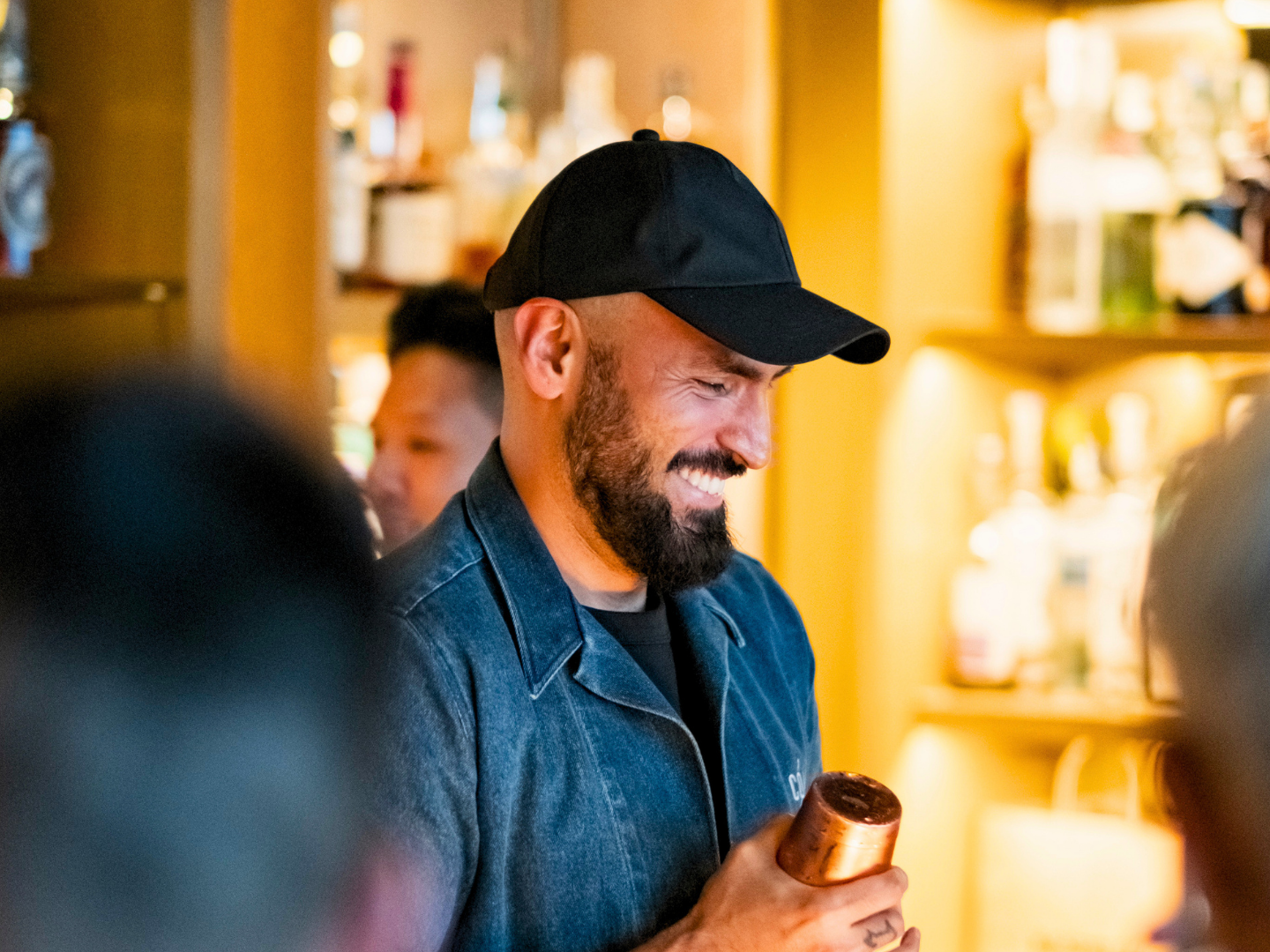
On the closing night of KL Cocktail Week 2026, Jay Khan brought COA Hong Kong to a borrowed space—someone else’s bar, someone else’s crowd. We sat down with him before he took the stage to talk about agave, hospitality, and what it actually takes to build something people remember.

Jay Khan flew into Kuala Lumpur on the third day of KL Cocktail Week and spent the rest of the festival moving through the city’s bars before landing here, on the final night, behind the bar at Cacao Mixology & Chocolate, Park Hyatt Kuala Lumpur. We sit down an hour before his shift, KL Tower and the Petronas Twin Towers framed in the glass behind him.
He is the founder of COA Hong Kong—Asia’s Best Bar for three consecutive years from 2021 to 2023—a forty-seat bar in Central built entirely around agave spirits that most of the world had written off as party shots. The bar has queues around the block most nights and a reputation that has a way of preceding him wherever he goes.
A Sense of Home
This is your first time at KLCW. What took so long?
I was supposed to be part of the first edition but I couldn’t make it. So I told Angie (of Three X Co): if you still want to have me, I will make sure I prioritise this. I’ve seen what the past two years looked like, and everybody I spoke to said this year is the best so far. From what I’ve seen, I believe it.
What impressed me most were the consumers. Bartenders are going to come anyway—it’s always the consumers that matter, and they showed up. The Festival Village was packed from early on until closing, a full house. That’s not easy to get at events like this, and it says a lot.
Coming from Hong Kong, which has one of Asia’s most mature bar scenes, what’s your read on where KL is headed?
The bartenders here are very well travelled now. They go around doing guest shifts in other cities, they know what the standard is like, and when they come back, they bring a piece of that experience home with them. There are some very cool bars here and I’ve had some really interesting cocktails. All I see is a good future for KL’s bar scene.

When you walk into a bar somewhere new, what do you look for?
As bartenders, we look at bars very differently than consumers do. We look based on how we feel. I go somewhere and if I know the people there, that’s already my favourite part. I don’t need the best cocktail in the world. A nice highball, a beer, I’m happy—as long as I get that familiarity with the team. A sense of home. That’s what I actually want.
What about when you taste someone else’s cocktail for the first time, what is your thought process?
First, whether what they’re saying is what they’re producing. Sometimes when a bartender makes you a drink, they tell you the whole story behind it. I want to know whether the drink is actually executed the way they described. Cocktails are about telling a narrative story, and if I drink it and it doesn’t taste like what the person said it would, that’s already enough for me. If it does, that ticks the first box. Then I look at the flavour combination, the balance, the temperature, the presentation. A lot of things, not just one.
It Sounds Like COA
You’ve said before that great bars are remembered not for the drinks but for how they made you feel. On a guest shift, without your own space or your own team, how do you make that happen?
It’s tough. When we do guest shifts in other people’s bars, it’s hard to bring that same energy, that same vibe. But what we can do is bring that sense of hospitality: how we engage, how we make people feel. We also play our own music, so if someone has been to COA before, they can relate: this sounds like COA. That familiarity travels even when the space doesn’t.
And the drinks themselves—how do you make sure they hold up outside your own kitchen?
We take this very seriously. A lot of guest shifts, I’ve noticed the drinks aren’t always at their best because of ingredient availability. When I come here, maybe the pineapples are different from back home. So every single ingredient that goes into the drink has to be as close as possible—what lime we’re using, what pineapple we’re using. We don’t just follow a strict recipe. We adjust based on taste, based on what’s in front of us. There’s no single answer to this, but we try to tick as many boxes as we can to make sure that the people who come to our shift have a good time.
You’ve mentioned you don’t drink much personally. How do you approach that in this industry?
I’m more health conscious now. If I don’t have to drink, I prefer not to. But I do like trying drinks. When I’m here in Malaysia, going around to bars, I want to see what the bartenders are creating. It’s all part of the job.

The Ingredients Need to Get to Know Each Other
Tonight’s collaboration is themed “Agave Meets Cacao”. How did that pairing come about?
Agave and cacao both came from the same part of the world. Many believe chocolate originated in Mexico, or at least in that region. Chocolate is a very big thing in Oaxaca. They use it in mole sauce, in drinks, everywhere. When we think about pairings, we look for two things: contrast, or mirroring. Contrast is something spicy against something refreshing—opposing forces that balance each other. But mezcal and chocolate is a mirroring pairing. Both are intense in flavour, both deeply dependent on terroir, both a little salty and mineral forward. They share very similar compounds. When you match their intensity, they lift each other. It felt very natural from the beginning.
Two of tonight’s drinks actually made the journey from Hong Kong. Tell us about that.
The Smacked Cucumber and the Mole Negroni can’t be served on the day they’re made. They need to be aged for a few days so the ingredients can integrate properly. When you drink them fresh on the day of prep, the cocktail feels very separated, like the components haven’t yet found each other. Leave them in the fridge for a couple of nights and the flavour becomes more combined, more complete. It’s similar to resting white wine in stainless steel before bottling. The ingredients need to get to know each other.

The Mole Negroni in particular—it uses cacao husk rather than the bean itself. Why?
Cacao husk is very porous thus much easier to infuse into liquid than the actual bean. We work with a chocolate company in Hong Kong that gives us their leftover husk after production. We cold infuse it using an ISI canister with nitrous oxide in a rapid infusion technique. What we want is the chocolate flavour and volatile aromatic compounds, but none of the bitterness or astringency that comes from heavier ones in the bean. A quick, clean extraction. It actually produces a stronger chocolate flavour than from the bean.
Walk us through the sequence of the four drinks tonight.
Start with the Paloma de Oaxaca—light and refreshing, your entry point for the evening before you go deeper. The Smacked Cucumber is a milk punch inspired by the Chinese smashed cucumber salad: savory, a little tangy, very clean. The Pepper Smash is vibrant, tart, and sour—for those who like that sharp kind of flavour; It is also one of the drinks that has been on COA’s menu since day one. Finish with the Mole Negroni—strong, a little bitter, with chocolate and chili running through it.

Your menu tonight has something for everyone—something refreshing, something savoury, something sour, something strong. Is that a principle you carry into every programme you build?
Always. A menu has to be balanced: there has to be a reason for every drink, and there has to be one for everybody. We also like our drinks with a touch of savory or chili—it’s something we carry from the Savoury Project. The Paloma has worm salt with chili on the rim. The Smacked Cucumber has chili in it. The Pepper Smash has jalapeño. The Mole Negroni has ancho. Each one a different style of chili, each one serving a different purpose. If a drink doesn’t have a reason to be on the menu, it shouldn’t be there.
It is a philosophy shared by Lee Wei Lung, Park Hyatt Kuala Lumpur’s own Beverage Manager—2024 Monin Cup national champion and World Class Malaysia 2026 top fifteen finalist, whose menu operates on the same basis: every drink must justify its place.

Write It Down
COA was built around a spirit most people dismissed. How did you find your way to agave?
I grew up in Hong Kong and realised very early that if I wanted to succeed in this industry, I needed my own voice. At that time, nobody in Hong Kong was doing agave—and it happened to be one of my favourite spirits. So I thought: pursue this, go to Mexico, learn everything I can.
One thing I realised early on is that people in Hong Kong could relate to mezcal through smoky whisky. Whisky smoke is more medicinal. Mezcal smoke is more like pit-fire barbecue: still smoky, but a completely different kind. If someone knows whisky, they can find their way to mezcal. Tequila was harder. Everybody had a bad experience with cheap shots at some point. So I thought: start with mezcal, then slowly bring them back to tequila. But good tequila.
Did you always know you’d open your own bar around it?
I had it all planned very early: what the bar would look like, the collection, the design, what I’d serve—without even knowing I would actually open one someday. I wrote it all down. When you write something down, it feels tangible. Much closer to achieving than just keeping it in your head.

How do you explain agave to someone who still thinks of tequila as a shot?
Mezcal is always the entry point. The smokiness gives people who know whisky something familiar to hold onto. And there’s a lot people don’t know about how regulated these spirits actually are. Tequila was the first product outside of Europe to receive a denomination of origin, not just in alcohol, but in any general product category. That was back in 1974. And even within Mexico, only five states are allowed to produce it today. Outside those five states, you cannot call it tequila.
These days many producers are choosing not to certify at all. They call it destilado de agave instead, which bypasses the regulatory bodies entirely. These can sometimes be better than what’s labelled tequila or mezcal, because they’re not constrained by export chemical standards. It’s purely about flavour. Bartenders know this, but most consumers don’t. That’s why education has always been at the centre of what COA does.
What’s the most overrated trend in cocktails right now?
Fermentation. A lot of bartenders ferment just for the sake of it because it sounds good on paper, but it doesn’t actually make the drink taste better. Fermentation exists for a reason: preservation in cold climates with only a few months of summer. But bartenders here are doing it purely for the concept, and the execution is often very poor. I genuinely can’t remember the last time I had a fermented drink in a bar that I actually enjoyed.
And to be honest, sustainability as well. Most bars that call themselves sustainable aren’t actually. If you want a sustainable concept, you need to live it. Apply it to your actual lifestyle, not just your menu. Otherwise it’s just greenwashing and copying what’s trendy without thought.

That’s A Good Night For Me
COA has clearly become something beyond a bar at this point.
Sometimes you realise that when you least expect it. I went to a concert once and we were having trouble getting in, but the guy at the door recognised me: oh, you work at COA, come on in! And just the other day I was in a perfume shop, just smelling perfume, and the shopkeeper came up to me: do you work at COA? I asked how she knew and she pointed at my COA tattoo. She said: what do you mean? It’s a famous bar! We get that sometimes and it’s one of the most rewarding things about what we’ve built.
How does COA maintain consistency across service, night after night?
Thirty minutes before every service, every single drink on the menu gets tasted from the glass—the way a guest would drink it, not a casual sip from a spoon. That’s when you really know what the drink tastes like. Ingredients vary by season. Something might be more sour or more spicy that week than the week before. If you taste it properly and there’s a problem, you adjust right away. If it can’t be adjusted, you don’t serve it. We’ve been doing this for seven years.
Lastly, what would a good night look like for you tonight—not for the guests, for you?
Selling out everything. Sometimes you do a guest shift, you prep so much, and you end up only selling two-thirds of it… and that’s not fun, because you’ve put so much time into preparing all those cocktails. If we sell everything tonight, that’s perfect. That’s a good night for me.

COA is located on Shin Hing Street, Central, Hong Kong, and currently ranks No. 38 on the World’s 50 Best Bars 2025. In 2022, Jay Khan opened COA Shanghai across four floors in the Jing’An District, each concept inspired by a different style of bar found in Mexico. @coahongkong
All images courtesy of Park Hyatt Kuala Lumpur.
From the table to the world beyond, Nacre brings you dining, travel, and lifestyle experiences worth savouring. Explore more with us on Instagram (@nacre.asia).

Leave a Reply